

Long-distance radio vs. short-distance radio, or 5G vs. mesh networks | Topics
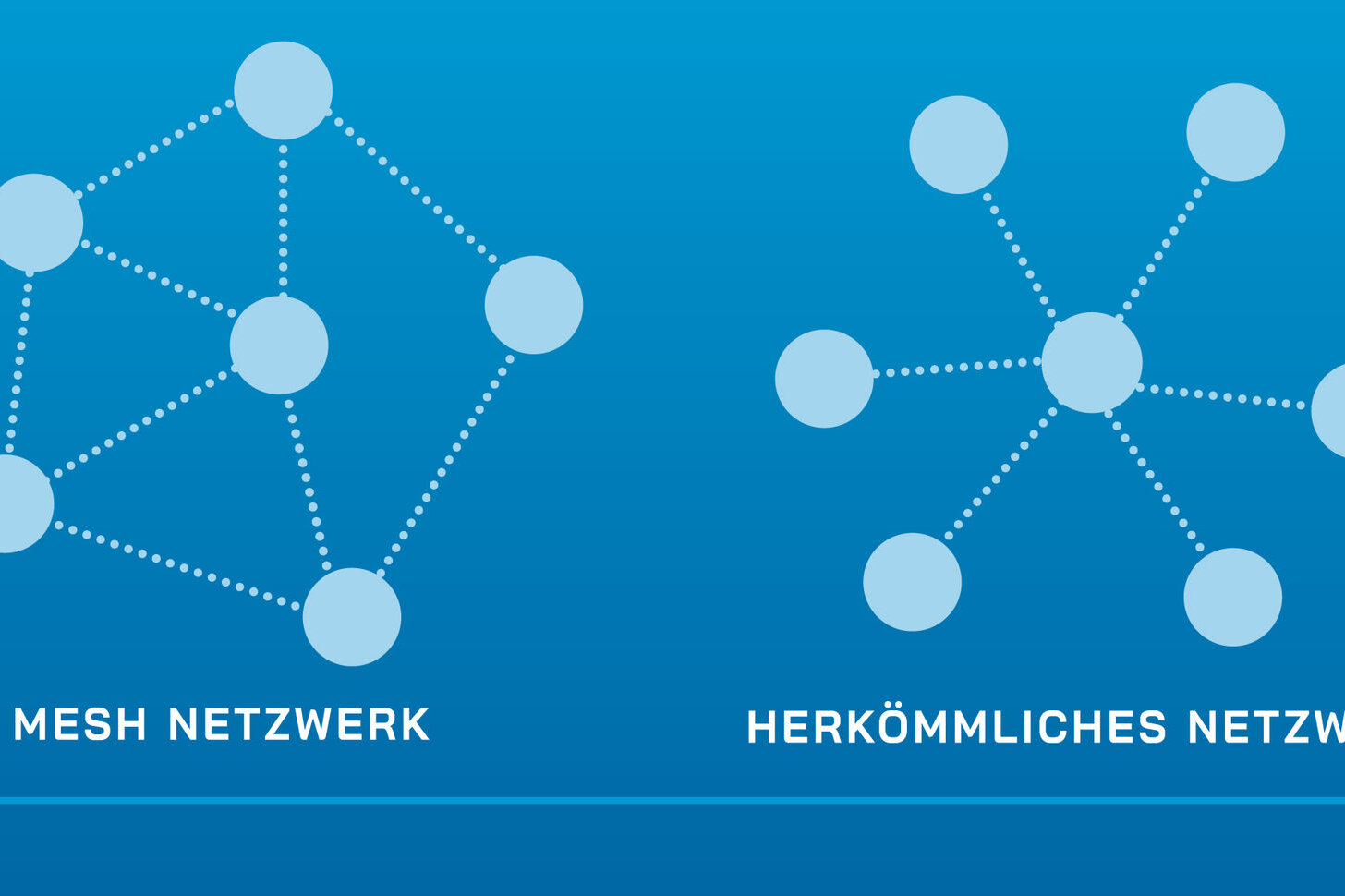
A comparison of 5G technology
5G – the fifth generation of mobile communications technology – is currently the talk of the town. But is the new standard really the ultimate solution for the Internet of Things? We set out a comparison of the technologies.
Wireless networks can be described primarily by three technologically and economically important characteristics: range, data transfer rate and energy consumption.
Improving one of these characteristics tends to have a negative impact on one or both of the others. A higher data transfer rate is usually accompanied by a reduction in range or increased energy consumption.
This trade-off is best illustrated by relevant, up-to-date examples:
- LTE: Moderate energy costs, long range, low data transfer rate
- Wi-Fi: High energy costs, medium range, high data transfer rate
- Bluetooth: Low energy consumption, short range, low data transfer rate
5G – The successor to LTE
5G is the technological successor to the currently used and widely adopted LTE technology. On the surface, 5G is all about increased speed. It offers a data rate approximately 10–20 times higher than LTE. It also offers improved features such as reduced latency, lower energy consumption and the ability to serve far more devices per base station simultaneously. The new mobile communications technology is highly flexible and can be tailored to specific needs. Potential applications include augmented reality, drone operations and autonomous driving.
5G – What is required?
5G requires completely new hardware across the board. This includes adapted end devices, mobile phone masts with different antennas and high-speed backbones such as fibre-optic cables. Although it is, in principle, a wireless technology, base stations and masts must be provided with sufficient bandwidth via wired connections to ensure that all users can be served quickly enough. If this is not the case, data may travel to and from the transmission mast at increased speeds, but will then be significantly slowed down by an old copper cable. The entire speed advantage over LTE would thus be lost.
In addition to the new transmission masts, these must also be erected at much closer intervals to one another than has previously been the case with LTE. As 5G transmits in a slightly higher frequency range, this also reduces the range. Some estimates suggest that a transmission mast would need to be built roughly every kilometre in Germany (in urban areas) to provide nationwide 5G coverage – an impossible goal.
The biggest problem with 5G deployment is therefore the lack of infrastructure currently in place. In fact, the technology cannot be used at present, as there are neither service providers nor transmission masts in place. Consequently, 5G unfortunately remains a vision for the future.
Mesh networks
As well as 5G, mesh networks are another option for wireless communication. Mesh networks can be implemented using various wireless connection standards. These include, amongst others, the widely used Bluetooth, as well as lesser-known standards such as ZigBee or Wirepas Mesh. There are no charges whatsoever for data transmission.
As a mesh network generally uses freely available radio frequencies, it inherently possesses certain fundamental characteristics, such as a relatively short range and a lower data transfer rate. However, it stands out in particular for its low energy consumption.
A mesh network is formed by a network of nodes that are interconnected. So, if node A wishes to send something to node B and the two are not directly connected, the communication passes via intermediate nodes until it reaches its destination. The following diagram illustrates a possible structure of a mesh network:
It is possible for all nodes to be connected to one another; this is known as a fully meshed network. If a node is connected only to ‘many’ others, this is referred to as a partially meshed network. Full meshing ensures optimum availability, as data transmissions are not interrupted by the failure of network nodes, whilst partial meshing, although it leaves gaps in the network, requires much less effort to set up and is therefore much cheaper.
In any case, the use of a mesh network allows a limited area, such as a factory site, to be comprehensively networked and monitored. Possible areas of application include: asset tracking, retrofitting (including control tasks), condition monitoring, smart buildings (e.g. with lighting control) and predictive maintenance. Devices spread over a very large geographical area cannot be adequately connected via a mesh network.
Flexibly adaptable routing protocols
Regardless of the type of meshing used, the network can operate and respond in various ways through customised routing protocols. The following examples are conceivable:
- If a node fails, the network can establish an indirect connection via other nodes, thereby maintaining the network’s reliability.
- It is possible to implement load balancing, whereby each node in the network is utilised equally. This allows bandwidth to be utilised optimally. Furthermore, energy consumption is distributed evenly across the network.
- The communication cycles of the nodes can be reduced in order to lower energy consumption whilst simultaneously extending battery life, for example when using sensors as nodes with the Wirepas Mesh protocol.
However, this high degree of adaptability also brings with it some disadvantages: depending on the extent of the adaptation, it can be very labour-intensive and the complexity of the routing protocols increases enormously. It may also be the case that all network nodes have to function as routers simultaneously. This increases the computing power required and, at the same time, the energy consumption.
Which technology is the right one?
Both the use of 5G and a mesh network have their advantages and disadvantages. A mesh network is ideal where there are no long distances to cover or where 5G cannot be used, for example due to a lack of network coverage or existing interference. A mesh network is particularly suitable for plant monitoring, M2M communication, asset tracking and similar locally confined communication. SYS TEC electronic offers various solutions in this area in cooperation with the network protocol provider Wirepas.
5G is a suitable option for transmitting data over long distances from widely dispersed field devices. However, this also requires adequate network coverage – which is not currently available. Until the roll-out and implementation of 5G for industrial applications is complete, older technologies must fill this gap. These include the aforementioned, somewhat slower LTE. The potential scope of application for LTE essentially corresponds to that of 5G.
However, the two technologies – 5G and mesh networks – are not mutually exclusive. It is possible to use them side by side or simultaneously. Due to their different technical characteristics and intended uses, they complement each other well.
