

Data-driven test strategies: AI in industrial test and inspection facilities | Topics
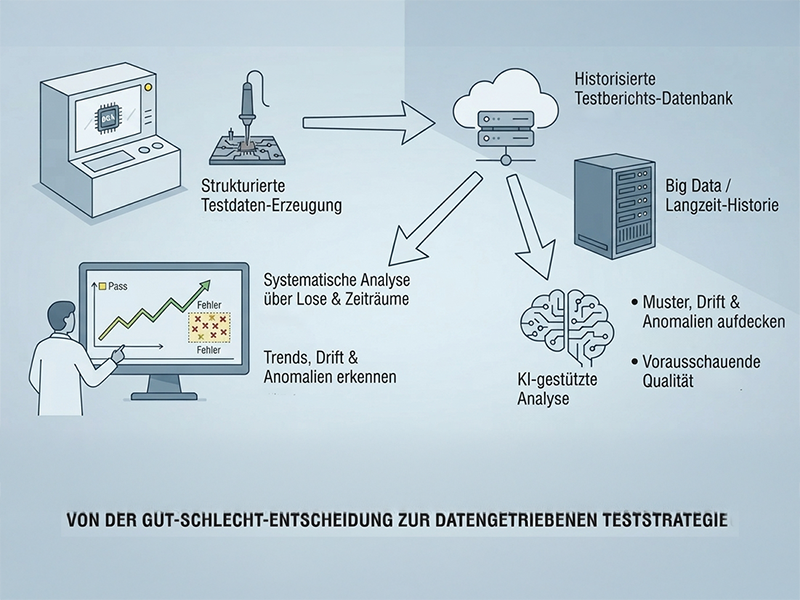
The greatest advantage of modern test systems lies not in the testing itself, but in the intelligent use of the test data generated, starting with the creation of structured test reports within the LabVIEW test application.
In many manufacturing environments, ICT, functional testing and burn-in generate large volumes of test data on a daily basis. However, this data is usually only used for the immediate pass/fail decision. As a result, considerable potential for optimisation remains untapped, because it is not the individual test that is the greatest driver of value, but rather the systematic analysis across batches and time periods.
Why test data is often underutilised
A test station provides a clear verdict for each assembly: pass or fail. This decision is necessary, but it is only the tip of the iceberg when it comes to what the measurement data actually reveals. Behind every ‘pass’ or ‘fail’ lie specific measured values, deviations from limit values, fault patterns and temporal trends. If this information is discarded after the test or merely stored in an unstructured manner, it is not possible to draw any reliable conclusions later on regarding trends, drift or gradual changes.
Modern test strategies therefore start one step earlier: with the question of how test data is generated, structured and archived. This is precisely where the real potential for optimisation lies.
The initial situation in manufacturing
In a typical electronics manufacturing facility, several test stages work together, each verifying different aspects of an assembly:
- In-Circuit Test (ICT) – verification of assembly, component values and electrical connections
- Functional test via pin-bed adaptor – testing actual functionality under realistic conditions
- Burn-in – stress testing over temperature and time to detect early failures
Each of these stages provides numerous measured values, threshold information, fault patterns and time-series data. If this information is stored in a structured format as a report within the LabVIEW test application, it creates a robust data foundation. The test application is therefore not merely a user interface or test controller, but a key component for transparency.
Test report generation in LabVIEW as the key to transparency
The crucial difference between a simple test bench and a data-driven test system lies in the quality and consistency of the reports generated. Standardised, uniformly structured test reports for each test specimen, assembly and batch ensure comparability, and it is only through this that reliable trend analyses become possible.
A comprehensive test report typically includes:
- Serial number
- Timestamp
- Production batch
- Test station
- Test programme version
- Measurement values
- Limit violations
- Error codes
- Test duration
- System or operator information
What batch analysis reveals about your production
Once test reports are consistently available, the analysis can be carried out at the level of a production batch. This reveals patterns that would otherwise be overlooked when examining individual items:
- Clusters of specific fault patterns within a batch
- Drift in individual measurement values over the course of production
- Differences between shifts, production lines or test stations
- Increased re-test or defect rates for individual variants
The operational benefits are immediate: anomalies are detected more quickly, the causes of faults can be pinpointed more effectively, and targeted measures can be taken instead of blanket rework across the entire batch.
Historical test data as an early warning system
The analysis only reveals its true strategic value when viewed across multiple production batches. The multi-batch history highlights trends that would be barely discernible in a single batch, across four key dimensions:
Production stability
Do measured values remain constant over a longer period, or are there gradual shifts and systematic fluctuations in certain processes?
Test system stability
Do the distributions of measured values change following a change of supplier? Do new variations emerge that might indicate changes in material batches or alternative components?
Sourcing effects
Do the distributions of measured values change following a change of supplier? Do new variations emerge that indicate changes in material batches or alternative components?
Chains of tolerance
Individual components are within their tolerance limits, but collectively they result in deviant behaviour. This is particularly relevant for analogue assemblies or those designed to operate at the limits of their specifications.
How procurement professionals benefit from test data
Test data is no longer just a technical issue. It is becoming a valuable decision-making tool, particularly for procurement and supply chain management. It helps to assess supplier quality more objectively, identify the implications of second-source strategies at an early stage, and provide data-driven evidence of quality fluctuations. Complaints can also be substantiated objectively, and procurement decisions are brought closer to the reality of production.
The practical link: if, following a change in sourcing, measured values or fault patterns shift, the test history provides a reliable early warning signal even before the problem manifests itself in scrap or field failures.
AI requires clean test data
This is where AI comes into play – not as a replacement for test technology, but as a means of enhancing the benefits of existing test systems. Data-driven analytical methods and large language models are already capable of:
- Identify patterns in large volumes of test data
- Detect drift and anomalies at an earlier stage
- Cluster similar error patterns
- Predict critical trends and prioritise anomalies
However, the prerequisite for this is always the same: structured data, consistent reports and a clear association with batches, test systems and variants. Such methods are already available today, but are not yet standard practice in all manufacturing processes.
The best foundation is laid during development
A robust test data strategy cannot simply be retrofitted at the test bench; it begins much earlier. At SYS TEC electronic, hardware and software development, a consistent focus on testability (Design for Testing) and our in-house test systems department all work in tandem. It is precisely this interplay that creates the best possible foundation for structured, analysable test data that can be compared across batches.
01 Development
Anyone who develops both the assembly and the test concept in-house is familiar with every relevant measurement point and can capture the correct characteristics right from the start.
02 Design for Testing
Testability is taken into account right from the layout stage: accessible test points, clearly measurable parameters and defined threshold values form the basis for accurate reports.
03 In-house test systems department
ICT, functional testing and burn-in, including LabVIEW test applications, are carried out in-house, along with the generation of structured test reports and data archiving.
This vertical integration is the key difference: test data is not a by-product that needs to be processed retrospectively, but a deliberately designed outcome of the entire development process. This allows the effects of manufacturing, test systems and sourcing to be clearly separated from one another right from the start, and this is precisely what is required for meaningful evaluations and the subsequent use of data-driven analysis.
The benefits at a glance
For technicians
- Faster fault diagnosis
- Better root cause analysis
- Greater transparency regarding process and test behaviour
- More informed optimisations of the test system and production
For buyers
- A clearer view of supplier performance
- Greater reliability when changing components
- Reliable data for complaints and approvals
- Closer collaboration with Quality and Engineering
For the company as a whole, this means: less waste, lower fault-finding costs, more stable processes, better traceability and, ultimately, higher product quality.
Conclusion
ICT, functional testing and burn-in generate valuable data, but the key to success lies in structured test report generation. Batch-specific analysis creates operational transparency, whilst the history across multiple batches reveals production stability, test system drift, supplier effects and tolerance chains. AI can already accelerate and deepen this analysis today, but it requires a clean database and is not yet standard practice in all manufacturing processes.
Using test data as a strategic resource
Would you like to make more targeted use of your test data for production and quality decisions? We’ll show you how ICT, functional test and burn-in data can be transformed into a robust evaluation strategy through structured test report generation.
This article is aimed at technical decision-makers, quality and production managers, and procurement professionals in the electronics manufacturing sector. Topics: industrial test systems, LabVIEW test applications, Design for Testing, batch-based test evaluation and data-driven test strategies.